

 Login
LoginVisit Colleges in the Spring
 Spring is the time to visit colleges. Arranging college visits during spring of junior year is an important step toward getting into a perfect-fit college. Your family needs to really get to know the college. Colleges can look very similar on paper, with brochures full of sunny days and beautiful fall leaves. Even when pictures and statistics look the same, you really don’t know what a college is like until you visit. Let me explain.
Social Sciences and High School History
 What is the difference between history and social sciences? The terms “social sciences” and “history” may be used interchangeably in high school and college requirements. Social sciences (or social studies), is a broader term having to do with human social interaction.
The Best High School Guidance Counselor Is YOU! (Original)
Unpublished August 2018
By Lee Binz
The HomeScholar
Guess who is the best high school guidance counselor? You are! And I can prove it! The average high school guidance counselor has 478 students. Based on this fact alone, it’s easy to see that the best high school guidance counselor is a loving parent, homeschooling naturally at home. You can homeschool high school fearlessly and confidently, knowing you are the best possible guidance counselor your child could ever have.
Currently, only two states meet the guidance goal of 200 students per counselor. You may feel out-numbered in your home, but you don’t have that many high school students by birth or adoption. Only 4 out of 10 public school students have ever (ever!) spoken to their guidance counselor.
On average, counselors spend 38 minutes per student during their high school years. Have you spoken to your child recently? How many minutes did you spend? It may have been more than 38 minutes before breakfast this morning.
For in-depth instruction on one of you most important tasks as a high school guidance counselor, register for my free class, "High School Testing - Simply Explained." In it, you will learn how to decide which test (e.g., SAT, ACT®, CLT) is best for your student and how to maximize your preparation time. CLICK HERE to register.
Take this quick assessment to determine your qualifications for this important job.
Qualifications Quiz
- How many adults (over 18 years old) are in your home? Give yourself 1 point for each.
- How many high school students are in your home? Give yourself 1 point for each.
- On a scale of 1 to 10, how well do you know these children? Add to the total.
- Have you spoken to your children today? Give yourself 1 point if “yes”.
- Do you have less than 478 students per adult? Give yourself 1 point if “yes”.
- Do you have less than 200 students per adult? Give yourself 1 point if “yes”.
Score: 10 points or more means you are well-qualified
A score of 10 or more points indicates a well-qualified homeschool guidance counselor! Assuming you are an average homeschooler, you could have up to four high school students at a time. Which school do you believe has the better student-to-advisor ratio? The average school or your homeschool?
Factor into this equation the simple fact that you LOVE your child. You are emotionally, sentimentally, and financially invested in their lasting success. Homeschool parents know that if they don’t properly prepare their children, they might be financially responsible for those children for the rest of their lives!
More importantly, you also have a huge emotional investment in your child’s success, because you want them to do well. High school guidance counselors do their job to the best of their abilities, but they don’t know each child. You don’t need to feel hesitant in your own abilities or feel the need for an official guidance counselor. What’s needed is you; you’re the best person for the job.
If you are only half as qualified as a public high school guidance counselor, you are still able to be a hundred times more effective. You have the numbers on your side, you know your child better than anyone else, and the love for your child motivates you to success.
 Don’t underestimate the importance of knowing and loving your child. I was getting my hair done one day, listening to two moms talk about their children in public school. One of them was describing how her child simply could not get through a Pre-Algebra class, which was too hard for him. The public school insisted that he move on to Algebra 1 but the school wouldn’t let him retake Pre-Algebra because he would fail, and they didn’t want him to be left behind. She asked her son during the first weeks of school how Algebra was going, and he replied that he was lost, had no clue what was going on, and felt he was going to fail. Two weeks into the quarter, she discovered that her son had been accidentally signed up for Calculus class. Instead of taking and failing Algebra 1, he was taking and failing Calculus.
As homeschool parents, we’re not perfect, but there’s no way we would make this mistake! We know our child and what they are capable of, so there’s no way we’d skip through three levels of math and put them in a class that’s way over their head. I understand that homeschoolers often feel inferior about their capability to counsel their children in high school. You have to admit that you would not make that kind of mistake.
Take this quick review of basic skills a guidance counselor uses to determine your readiness for the job. The U.S. Department of Education reports that 92 percent of high school guidance counselors perform five important tasks. Can you do these things?
Skills Assessment Quiz
- 1. Use College Catalogs
Can you read, and use a catalog? These substantial catalogs resemble gigantic phone books, and you can find them in public libraries. If you know where your public library is or know how to buy books online, give yourself 1 point. - 2. Individual Counseling Sessions
Have you spoken to your teenager recently? Would you consider it an individualized conversation? (Focused on your teen or their needs.) If so, give yourself 1 point. I know that in various high schools, guidance counselors ask that a student bring a list of their activities, or a resume with them when they meet. If you had to ask your child to bring a resume to your individual counseling session, subtract 1 point. - 3. Use Computerized Career Information
Computers tend to be found in homeschoolers’ homes and some use the computer at a library or resource center. If a computer is not available, a librarian can direct you to career information sources in print. If you know where your public library is or you know how to make use of a computer, give yourself 1 point. - 4. Use Non-computerized Career Information
If you have spoken to your child about getting a job, if your child has ever earned money in any way or held a non-paying job of any kind, or if you know how to make use of your public library, give yourself 1 point. - 5. Coordinate and Interpret Tests
There are two websites that offer all the information you need to schedule and understand high school tests: Collegeboard.com and ACT®.org. If you can locate these websites on the internet, give yourself 1 point.
Score: 5 points or more means your skills are sharp
How did you score? If you received 5 points, you are capable of offering the same service as a public school guidance counselor. Less than 5 points may warrant remedial computer services. Just ask your teen. You’ll be up to speed in no time!
How to be the BEST Guidance Counselor
You are qualified and have the necessary skills. Let’s talk about what will help you become the best guidance counselor for your homeschool teen.
1. Focus on Flexibility
Teenagers will change their minds, which means focusing on being flexible. College preparation is important for all students. College-bound students need coursework designed to prepare them for college studies. Students need to take college admission tests and parents must learn about grades and credits. College-bound students need a homeschool diploma and a homeschool transcript. College preparation for college-bound students is expected.
But have you ever taken into consideration what a college preparatory home education might offer for students who will not go to college? Rigorous academics could benefit children even though they are not planning for higher education. Without college, a homeschool education could be the only formal education a student gets. Academic preparation will not hurt anyone and if they don’t go to college, it won’t go to waste. College preparation may help your child be a more effective employee or business owner, a smarter citizen, and a confident homeschool parent. Planning for college can’t hurt your child and it delivers flexibility for the future.
2. Become the Project Manager
Homeschool parents assume four main roles throughout their children’s lives: caretaker, teacher, mentor, and friend. During high school, the teacher role becomes increasingly less important. College preparation necessitates that you take a “project manager” role. Our job gets to be more administrative, however it is not going to become more time-consuming or complicated. It’s simply different.
 3. Plan Courses
Plan your high school classes. Throughout eighth and ninth grades, find out about your own state requirements and try to make a system to meet those requirements. Look at the common college expectations for recommended high school courses. Look over and adjust your high school plan each year. Budding nurses and engineers might have to buckle down on math, and those getting ready to be missionaries could benefit from additional foreign languages. Learn to develop a flexible, big-picture plan with my article, “Planning High School Courses.”
4. Plan for Tests
Arrange for standard high school tests. Which tests should your child take, when do they take them, and how do you know? The majority of the answers are found on two websites: CollegeBoard.com and ACT®.org. Register your child for the PSAT/NMSQT® in 10th grade for fun, and in 11th grade to be considered for the National Merit Scholarship. College admission tests, such as the SAT and ACT®, are typically taken in spring of 11th grade and repeated in senior year only if necessary. As a homeschooler, you can help your child get the best possible SAT or ACT® score with the least possible stress. Subject tests are best taken immediately after your child finishes each subject; they are required by some colleges.
5. Encourage Extracurricular Activities
You desire your child to be well-rounded and so do colleges. Encourage your child to volunteer or seek employment, internships, or apprenticeships. Encourage activities such as sports, music, and art. Colleges love to see kids who are enthusiastic about something. They can see this elusive enthusiasm in extra-curricular activities students maintain through all four years of high school.
6. Find Appropriate Colleges
To accomplish your intention of selecting ideal colleges, the first step is to go to a college fair. Comparable to a homeschool convention, a college fair is a fast, straightforward way to learn a lot about multiple colleges in a brief amount of time. Step two is getting your child to take the PSAT/NMSQT® in October of junior year. Third is taking time to stop by colleges during the year, so you can eliminate poor choices from your list. The fourth step is taking the SAT or ACT® in the spring, which might help you discover the appropriate college fit both academically and financially.
7. Contemplate College Finances
We all know we should be saving for college, however intentions don’t always match reality. Regardless of your saving success, learn how homeschoolers earn scholarships. Don’t be afraid to consider private colleges. They sometimes provide considerably better financial aid than public schools and usually their costs are comparable. College tuition is like buying a car. Hardly anyone pays the sticker price, so don’t be afraid of a school’s list price.
In October of senior year, you need to complete the FAFSA®. The Free Application for Federal Student Aid is an IRS-style form that helps colleges decide how much money the government believes you will be able to afford to pay for college - usually with comical results! Here we are having to worry about the price of gasoline, and they think we can manage that amount? The FAFSA® is used to find out how much financial aid colleges will award.
8. Prepare High School Records
When you determine which colleges your child will apply to, ask each college what high school records they need from you. It can vary drastically and there is no way to know unless you ask. They may only request a transcript.
Some colleges may also want to see a simple reading list, but others will want exhaustive course descriptions and grading criteria. Sometimes they have unusual and unique requirements. The quality of a student's high school record is the most important factor in college admission decisions. Most colleges require, request, or appreciate course descriptions.
Find out their requirements early on to make sure you can give them what they need. I always advise keeping everything in high school – you never know what colleges will want. One college asked me for an English paper that I had graded. Another college needed subject tests in several different areas. Like a Boy Scout, always be prepared! At the end of homeschooling, at the end of senior year, don't forget to send the college a final transcript that includes graduation date, final grades, and grade point average.
 9. Apply to Colleges
Guide your child through the college application process. College applications are generally lengthy and complex. Admission essays will be tedious and time consuming. Plan to begin the application process during September of senior year to allow enough time to complete it. It’s possible to write college application essays in junior year if you prefer to plan ahead. You can always alter them before submitting.
10. Apply Early in Senior Year
Each college may require two or more essays, and each application could be many pages. Quite often, admission and financial aid decisions are “first come, first served” which means it can be worthwhile to plan ahead. I encourage students to finish applications by January first whenever possible, to be in the best situation. The college deadline might be later, but they will be overloaded with applicants near the deadline. They can give your child’s application a more relaxed reading if you turn it in early.
11. Keep it Simple
You have only one goal per year during the four years of high school. In freshman year, all you have to do is contemplate college. Sophomore year is the time to prepare for college. The focal point of junior year is selecting a few colleges where your child would like to apply. During senior year, the main goal is completing college applications.
12. Take Continuing Education
If you spend just a few minutes each month thinking about what you need to do, you'll never fall behind. You are prepared to be a great high school guidance counselor. For the best success, take continuing education seriously. Read books and take classes about homeschooling high school each month to get a gentle reminder about your current tasks.
For parents of college-bound students, continuing education is even more important. Knowing what to do and when to do it can make a huge difference in the amount of financial aid and admission offers. The College Launch Solution will teach you everything you need to position your high school student to receive the best possible admission and scholarship awards, and then help them succeed throughout college and into their career.
Be Brave and Have Confidence in Homeschooling
The guidance counselor at a public school has a huge job. Hundreds of students, with only eight hours in a day. They are responsible for the college and career plans of hundreds of kids they don't know. Our job as homeschool parents is significantly more manageable. We are only responsible for our own children, whom we know extremely well.
Homeschoolers have the advantage in college preparation! We are intimately involved in our children’s education. Because of this, we truly recognize their strengths and weak points, their ambitions and passions. We can offer the best guidance counseling for them because we are love-givers, not just care-givers. In school settings, a guidance counselor may know about tests and deadlines, but they have hundreds of students to guide and might only speak to each student once or twice. Just like our fantastic student-teacher ratio, our student-advisor ratio can’t be beat!
Be brave! You know your child better than anyone and you are completely capable of offering the guidance they require through high school. You can do it! "Remember, amateurs built the Ark. Professionals built the Titanic."
The Best High School Guidance Counselor Is YOU!
(Click image to see it full-size.)

To share this infographic, grab the embed code below!
Recommended ResourcesSuper Scholarships for Humble Homeschoolers
Free Class!You can afford college! How? I want to show you how to earn BIG merit based scholarships you thought were reserved for the uber-intelligent or Olympic-level athletes. These scholarships are available for homeschoolers, even kids that are academically or athletically dis-inclined. In fact, one of the best ways to position your kids for these scholarships is by leveraging the educational benefits available EXCLUSIVELY to homeschoolers.
In this class you'll learn why merit scholarships provide the most money. I'll teach you which college admission test is best, the SAT or ACT®, and why. I'll show you how to make SURE your child will stand out above the crowd, regardless of their gifts or challenges. You'll learn how to find a college that gives great scholarships, and the secrets to creating homeschool records that will reduce college costs.
How to Homeschool College
Avoid College Debt and Fast Track Your Degree!
[Kindle Book]Do you ever wonder whether a 4-year traditional college education is the best choice for your homeschool graduate? Have you ever cringed at the expense and time it takes, but figure there are no alternatives? Homeschooling college is not a new idea—people have been doing it for years via distance learning—and it’s become very popular lately, especially with homeschooled graduates.
For the student who is willing to put in the work, homeschooling college can be an effective and economical fast track to a college degree. “How to Homeschool College” lays out all the different methods of earning college credit, based on the author’s experience with her own children.
The College Launch Solution
Learn Secrets to Successfully Launch Your Teen into College and LifeFor parents of college-bound teens, this resource will provide you all the training, resources, and support you need to become the best possible college coach for your student. You will get the vital information you need at a fraction of the cost of hiring a professional college consultant.

![How to Homeschool College: Save Time, Reduce Stress, and Eliminate Debtd [Kindle Book]](https://s3-us-west-2.amazonaws.com/hhhimages/3D-Kindle_how-to-HS-college.png "How to Homeschool College: Save Time, Reduce Stress, and Eliminate Debt [Kindle Book]")

Copyright © 2018 The HomeScholar LLC, www.HomeHighSchoolHelp.com. Text may be reprinted without permission if used in full, except for use in a book or other publication for rent or for sale. Reprint must include this copyright, bio (below), and the original URL link - https://www.homehighschoolhelp.com/the-best-high-school-guidance-counselor-is-you
Lee Binz, The HomeScholar, specializes in helping parents homeschool high school. Get Lee's FREE Resource Guide "The 5 Biggest Mistakes Parents Make Homeschooling High School" and more freebies at www.HomeHighSchoolHelp.com/freebies.
The Best High School Guidance Counselor Is YOU!
You are the best high school guidance counselor for your teen. You can be the most effective in leading your child through homeschool high school and into college and life. The average high school guidance counselor has 478 students. Based on this fact alone, it’s easy to see that the best high school guidance counselor is a loving parent, homeschooling naturally at home.
Taming Middle School Anxiety
Unpublished
July 2018
By Lee Binz
The HomeScholar
Awkward Age
Middle school can be the sweetest, most rewarding time to homeschool! Parents can gently guide their preteen through the physical, intellectual, and social changes that come with this age. If you have been homeschooling successfully, nothing dramatic will happen when your child changes grade levels and enters middle school. They will still have the same learning style. The strategies that worked for you before will still work. You can reconnect with your child and prepare them for high school and beyond. Middle school doesn't have to be the train wreck you remember or have seen depicted on TV! You can ensure your child learns appropriate behavior in the safety of your own home.
Many homeschool parents still feel anxious about middle school. Parents can find themselves suddenly staring across the breakfast table at strangers. Delightfully compliant children can suddenly act out like surly teens with attitude. Thankfully, as homeschoolers, we can shape and mold our children through this process, even during bursts of hormonally-charged awkwardness.
Homeschooling middle school and high school can seem like a daunting challenge to even the most seasoned homeschool parent. Wouldn't it be wonderful to have a proven road-map showing you how to get the most out of your experience while sidestepping all the traps? You can! The HomeScholar High School Solution can help you at your point of greatest need. Providing a wide array of reading will help each child find enjoyment in reading.
Read more to gain a healthy perspective about middle school education and prepare your child for their high school years.
The Goal of Middle School
The goal of middle school is to prepare your children for high school. Middle school is called Junior High School in some areas. It usually includes grades 7 and 8, although it sometimes includes grade 6 or grade 9 as well.. It’s intended to provide a gradual and age-and-ability appropriate transition between the elementary school and high school.
Whether your child is ahead of the curve, or struggling in one or more areas, you simply can’t be “behind” in middle school. Educate your child to meet their current needs, whether they are remedial, on track, or advanced. In fact, the best thing that you can do in middle school is to instill of love of learning, so they look forward to high school. With hands-on learning fun sprinkled in, they’ll hopefully be eager for the in-depth learning in years to come.

Middle School's Purpose for Parents
First, your purpose is to understand middle school. It is normal during this awkward age for children flit back and forth between childishness and maturity. Understand that there is a wide variety of abilities between different middle schoolers. Some are super-star academics with excellent work ethic. Some are gifted or academically capable. Others are challenged in one way or another. This wide range of normal was why middle school was created, so college-bound students could do college-prep work not available in elementary school, and remedial students could boost up their skills in preparation for high school level work.
Second, your purpose is to learn about high school. Nationally, most parents stop homeschooling during or after middle school, and in my experience it’s overwhelmingly because of fear. You can remove the fear of homeschooling high school during 7th and 8th grade. Read your state homeschool law. Learn about high school record keeping, and class selection. Get a general understanding of tests. Once the fear of high school is removed, parents are more able to make informed decisions that are best for their children. Again, the High School Solution will give you a deep understanding and confidence about homeschooling high school
Middle School's Purpose for Students
Middle school is a pause between elementary school and high school. The pause was developed because children learn at different rates – not only homeschoolers, but all kids! So, the pause is used to give slow or reluctant learners a time to catch up before high school. At the same time, it gives quick and academically capable children a chance to continue learning at their level.
The first purpose of junior high is to give struggling students some remedial help. Students below grade level in math can spend the time focusing on math. They can use the time to get up to grade level again. These children aren’t behind. They are using the time given to them for this purpose.
The second purpose of middle school is to allow students ahead of grade level to move straight into high school level work. Children doing high school level work competently, using high school level material with understanding, can include high school credits on their transcript. Algebra 1, biology, and perhaps a foreign language, are common high school level classes that may be taught in junior high.
7 Big Benefits of Homeschooling Middle School
Below are the seven greatest advantages you will see if you decide to homeschool middle school. These are real benefits for you, your child, and your family.
- Social benefits: parents have time to shape and mold behavior and ensuring a wholesome environment in curriculum choices and extracurricular activities.
- Physical benefits: physical maturation rates vary dramatically. So whether students are adult-looking or not, parents can provide appropriate content for their child.
- Character benefits: parents have the time and ability to instill the values, work ethic, and morals of the family.
- Family benefits: with additional time with parents and family members, homeschoolers are creating memories and bonds that last a lifetime.
- Problem solving: rather than facing challenges alone, as students interact with others they have their parents close by and can discuss tough situations that arise.
- Academic benefits: each student can proceed at their pace in each subject all the time, with their unique learning style in mind, to maximize the love of learning regardless of ability level.
- Curriculum benefits: parents can choose curriculum appropriate the maturity level, academic need, and learning ability, keeping children challenged, but not overwhelmed.
In elementary school, parents learn that children read on their own unique time-table. This is true in middle school as well. Parents can’t force a child into puberty early, neither can they force algebra or logical understanding before they are ready either. Take it one step at a time.
Remedial, Ready, or Right

Whether your child is remedial or advanced, you can keep their subjects challenging, but not overwhelming. Middle school is the time to advance in subjects when the student is ready, but it’s also the time to review subjects that still need more time. Some children are right at grade level. Not all children are at a remedial level or ready for advanced classes. They don’t all have to be doing remedial work or high school work; you can do remedial work in certain areas and move ahead into high school work in other areas. This is a far superior situation for your child than the typical “assembly line” public school.
Many students are right in the middle! Your job is to teach your children at their level in each subject, all the time. Your child might be on grade level for everything but math, or excel in foreign language but suffer in writing, with other subjects right on target. The joy of homeschooling is being able to provide for your child’s academic needs in every subject. They aren’t grouped into broad age-based classrooms, but are being taught precisely at their level.
The good news about junior high is that it’s absolutely impossible for you to be behind. If your child is below grade level and they’re in 7th or 8th grade, then work on getting them up to grade level again.
Test Preparation
The best test preparation is a well-educated student, not a well-prepped student. Cover English skills like vocabulary, spelling, simple grammar, reading, and writing. Include math, history, and science each year, and you will do more to increase test scores in high school.
Do not give the SAT® or ACT® test that is beyond their ability. When exposed to tests they simply can’t succeed in, students can develop test anxiety, and feel less confident about tests in general. Instead, use a grade-level test that’s age-appropriate (like the ITBS for 7th grade or CAT-8) so you get a truer measure of ability. One grade-level standardized test each year will give you the information that you need about academic achievement. It will also give the student one experience per year taking a standardized test with a group of friends. They don’t need to prepare for that test, they are simply taking it for practice and you can use the results to guide your curriculum choices next year, while students comfortable with filling in bubble tests in a group, while being timed.
Early High School Credits in Middle School
If your child is doing high school level work in an academic subject area like math, science, or foreign language, put that on your transcript. Students who pass these courses and the final exam will automatically be granted high school credit. These grades will be reflected on the student’s high school transcript and included in cumulative GPA calculations.
These early high school courses must have the same expectations, curriculum and final exams as the equivalent courses taught in high school. In public schools, they often allow early credits only in math (algebra 1 or higher), science (high school biology or higher) and foreign language (using a high school curriculum.) In other subjects, I don't recommend using early high school credits, but of course the parent always knows best.
Middle school is the perfect time to build a love for reading. Here are some great books to use. Click to download: The HomeScholar Middle School Reading List
7 Big DON’Ts of Middle School
Create sensible academic strategies and remain balanced. Avoiding these seven common blunders of middle school parents will help you avoid burnout and move forward with confidence.
- Don’t expect instant maturity
- Don’t expect consistent behavior
- Don’t expect learning styles to change
- Don’t expect complete independence
- Don’t compare – someone will get hurt
- Don’t overwork and burn out your student
- Don't include test prep for the SAT® or ACT®
7 Simple Steps to Middle School Success
If you tend to get stressed by too much information, read no further! But if you are a parent who likes to plan ahead, I have some additional suggestions.
1. Make a Plan
You will find it helpful to plan your middle school and high school courses. A rough draft with a five-or-six year plan can eliminate some of the “Oh, no! High school!” panic I sometimes see in parents. Develop a plan that will include English, math, science, and social studies each year. Consider introducing a foreign language in middle school, so you can ease into it, allowing for plenty of time to get the two to three years of foreign language many colleges require.
2. Cover the Basics
Your child will need to know how to read fluently and write understandably. They will need to understand key math concepts, so they can build on those skills in high school. Encourage the love of learning with delight directed activities when possible. Reading, writing, math, and attitude are the four cornerstones of study skills.
3. Develop Study Skills
Teach your child to complete assignments when directed and to take a test calmly, without anxiety, for optimal performance. Provide assignments so your student can complete work on their own while learning time management one day at a time at first. Later, give assignments one whole week at a time. Much later in high school, your child will be ready for long term assignments, perhaps one month at a time.
4. Encourage Organization
Provide an organized study space, with necessary tools at hand. Have a place to keep papers – perhaps a notebook for each subject. Encourage your child to work with a schedule or assignment list and to use a calendar for assignments. When they have a regular time, place, and procedure for studying, your child is more likely to take those habits with them after high school. Explain how to manage their assignments. It often works to do the “worst first” - the most difficult or least enjoyable subjects first. It also helps to break big projects into smaller steps. Estimate time for each step.

5. Practice Time Management
Help your child to understand time commitments to make sure expectations are reasonable while they balance school and friends. Encourage your child to take regular breaks. I suggest about 30 to 50 minutes of study, with at least 10-minute breaks. This is even more important for active learners, young men, and athletes. Regular exercise breaks, especially strenuous activities, can help teenagers manage hormones. Remind your child that daily study is most effective. Avoid letting them cram for tests or writing papers, as can sometimes happen in co-op and classroom settings.
6. Research College Financing
College financing can be confusing, so spend time investigating options well in advance. Although earlier is easier, it’s not too late to begin saving for college. Research the College 529 Plan. Learn about the different investment plans available, and try to start setting money aside now. Estimate the financial aid you might receive from colleges. To do so, use the FAFSA® forecaster at www.fafsa4caster.ed.gov. There's a good article by FinAid on the basics of saving for college. FinAid: Saving for College.
7. Do Not Panic
Focus on learning and you can’t go wrong. When you genuinely care about your child's education, you are taking the necessary steps for high school. A variety of different homeschool methods can be successful. You don’t have to change your method of homeschooling when you are thinking about high school or college. Instead, focus on learning on purpose each day. When your child is in middle school, you can’t be behind. Do your best to educate your child and you won’t go wrong!
Relax and enjoy homeschooling while you successfully navigate 6th through 8th grades. You can maintain the love of learning, and homeschool middle school with powerful purpose, but it never has to be overwhelming. Would you like to read more easy to implement ideas to homeschool with peace and calm? Learn to make reading fun with these easy-to-implement ideas. Read 7 Ways to Encourage Reading in Middle School, and get a free printable middle school reading list. Encouraging reading can be a fun way to help children love learning. When reading is enjoyable, children see homeschooling as a fun educational option, not a chore forced on them by a taskmaster.
Would your middle schooler rather do chores than read? You need better books! Click to download my list of the best out there: The HomeScholar Middle School Reading List
Relax and Enjoy This Season
Take a deep breath. Be calm. Relax and enjoy homeschooling while you successfully navigate 6th through 8th grades. You can maintain the love of learning, and homeschool middle school with powerful purpose, but it never has to be overwhelming. Would you like more easy-to-implement ideas to homeschool with peace and calm? Learn to make reading fun with these easy-to-implement ideas. Read 7 Ways to Encourage Reading in Middle School, and get a free printable middle school reading list. Encouraging reading can be a fun way to help children love learning. When reading is enjoyable, children see homeschooling as a fun educational option, not a chore forced on them by a taskmaster.
Taming Middle School Anxiety
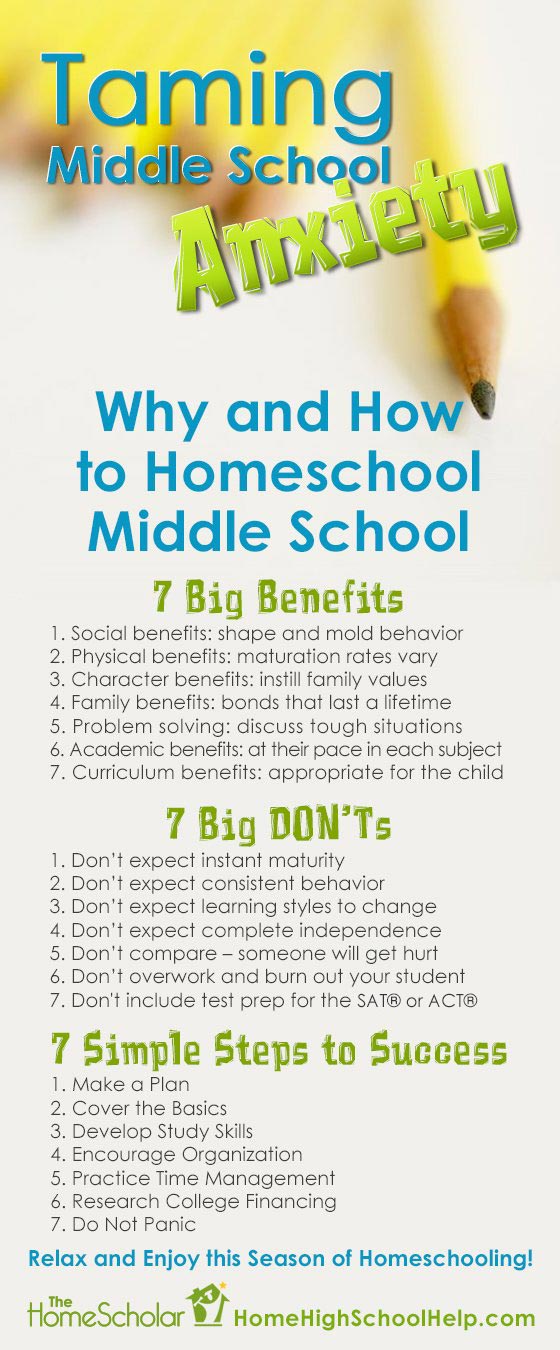
To share this infographic, grab the embed code below!
SAT®, AP®, CLEP®, and SAT Subject Tests™ are trademarks owned by the College Board, which is not affiliated with, and does not endorse, this blog post or The HomeScholar, LLC.
Copyright © The HomeScholar LLC, www.HomeHighSchoolHelp.com. Text may be reprinted without permission if used in full, except for use in a book or other publication for rent or for sale. Reprint must include this copyright, bio (below), and the original URL link (https://HomeHighSchoolHelp.com/take-the-psat-for-fun-and-profit).
Lee Binz, The HomeScholar, specializes in helping parents homeschool high school. Get Lee's FREE Resource Guide "The 5 Biggest Mistakes Parents Make Homeschooling High School" and more freebies at www.HomeHighSchoolHelp.com.
"How to Avoid the 5 Biggest Mistakes Parents Make Homeschooling High School" - Free Workshop
Avoid Stumbling Blocks and Pitfalls on Your Way to Homeschool Graduation!Learn how to identify and avoid the big blunders repeated by countless homeschool parents:
• The First Mistake may cripple your plans if your child ever changes their mind (and what teenager doesn't)!
• The Second Mistake may leave your child unprepared for college!
• The Third Mistake may result in the loss of thousands of dollars in financial aid!
• The Fourth Mistake may cause your child to be lost in the crowd during college admission!
• The Fifth Mistake may render your kid unable to gain admission to the college of their dreams!
Homeschooling Middle School with Powerful Purpose: How to Successfully Navigate 6th through 8th Grade
(Coffee Break Book) [Kindle Edition]Learn why "old-fashioned" homeschooling is still your best bet for growing passionate learners! Homeschool independently and take your life back! Instead of a "one-size-fits-all" assembly-line education, choose the freedom to teach your children at their pace and consistent with your values. Pursue happiness while homeschooling, instead of pursuing the busyness so common in our society.
Learn to identify and eliminate sources of educational dependence, regain your peace of mind, and rekindle your children's love of learning. Be a fearless leader! Declare your independence from the public system and rigid classroom structure. Create a perfect fit education for your child.
The HomeScholar High School Solution
Guidance for Every Age and StageIf you are a beginner to homeschooling high school, consider the High School Solution, which provides detailed training on homeschooling all the age groups, from middle school through senior year. The resources included give specific help for all stages, from getting started, planning high school courses and understanding high school testing, to college admission and scholarships.
Get complete instruction for choosing curriculum, encouraging delight directed learning, and teaching advanced subjects through training classes for parents, all with handouts or workbooks plus articles and templates.

Copyright © 2018 The HomeScholar LLC, www.HomeHighSchoolHelp.com. Text may be reprinted without permission if used in full, except for use in a book or other publication for rent or for sale. Reprint must include this copyright, bio (below), and the original URL link (http://www.homehighschoolhelp.com/taming-middle-school).
Lee Binz, The HomeScholar, specializes in helping parents homeschool high school. Get Lee's FREE resource guide, "The 5 Biggest Mistakes Parents Make Homeschooling High School" and more freebies at www.HomeHighSchoolHelp.com.
More Articles ...
Page 2 of 20
Amarillo, TX 79106
Phone: 1-888-533-2435
Opening Hours: Monday to Friday: 9.00 am to 03:00 pm (PST)
